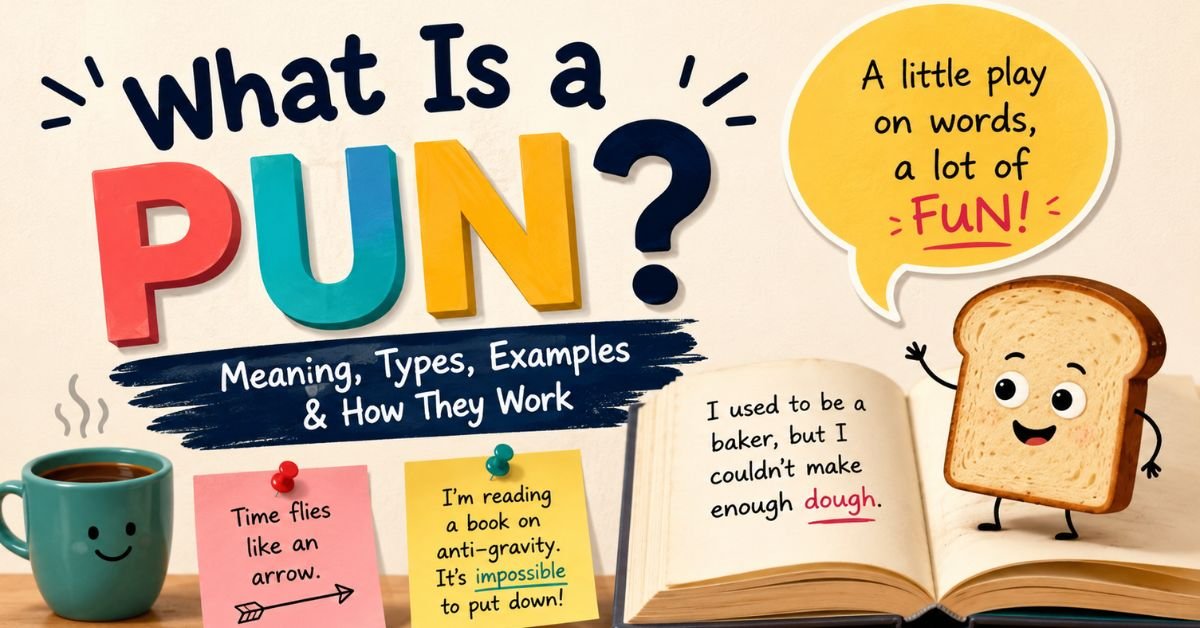
What Is a Pun? Meaning, Types, Examples & How They Work
If you’ve ever groaned and laughed at the same time, you’ve probably just heard a pun. Puns are one of the oldest and most common forms of wordplay, showing up in everyday conversation, headlines, advertising, and centuries of literature. This guide breaks down what a pun actually is, how puns work, the different types you’ll come across, and plenty of examples along the way including ones simple enough for kids.
What Is a Pun? Meaning and Definition
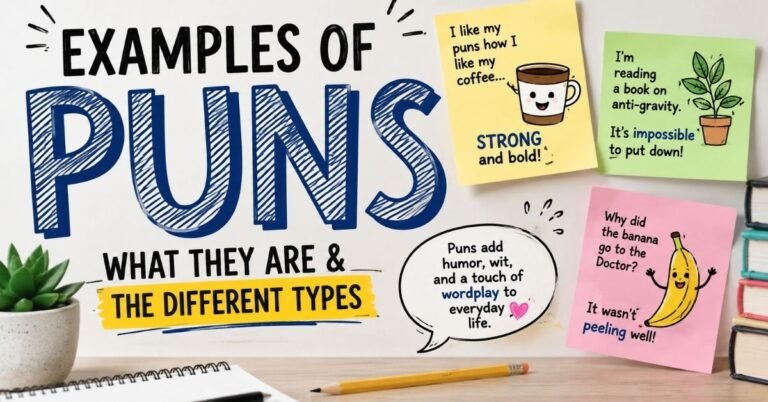
A pun is a form of wordplay that uses a word’s multiple meanings, or the similar sound of two different words, to create a humorous or clever effect.
In simple terms, a pun takes advantage of the fact that language is a little messy. The same word can mean two different things depending on context, and two completely different words can sound almost identical. Puns lean into that overlap on purpose.
Here’s a quick example: “I used to be a baker, but I couldn’t make enough dough.” The word “dough” works two ways here, it’s the ingredient bakers use, and it’s slang for money. That double meaning is the whole joke.
Puns are considered wordplay because they don’t rely on a story, a setup, or a situation the way many jokes do. The humor lives entirely inside the language itself in the word choice, not the plot.
How Do Puns Work?
Most puns work through one of a few basic mechanics. Once you can spot these, you’ll start noticing puns everywhere.
Using Words With Multiple Meanings
Some words carry two valid meanings, and a pun puts both meanings to work in the same sentence. The humor comes from realizing the sentence makes sense both ways at once.
Example: “I put my new alarm clock on a diet, it’s been losing time ever since.” Here, “losing time” means both running slow and, jokingly, shedding minutes the way a diet sheds pounds.
Playing With Similar Sounds
Other puns rely on two different words that just happen to sound alike. This is where the ear does the work instead of the meaning.
Example: “The medieval reenactment only happens after dark, since that’s when the knight comes out.” Say it out loud, and “knight” and “night” do all the heavy lifting.
Twisting Familiar Words or Phrases
A third approach takes a phrase everyone already knows and bends it slightly to say something new.
Example: “Curiosity killed the cat, but satisfaction brought it back, mine just keeps knocking things off the shelf out of curiosity.” The familiar saying gets stretched to fit a new, specific situation.
Most puns you’ll come across use one of these three approaches, or a combination of them.
Read More About : Zoning Out? These 150+ Coffee Puns Will Perk You Right Up!
Different Types of Puns
Puns are usually grouped into a few recognized categories, based on exactly how the wordplay is built. Here’s a breakdown of the main types, with examples and a quick explanation of why each one works.
Homophonic Puns
What they are: Homophonic puns use two different words that sound the same (or nearly the same) but have different spellings and meanings.
Examples:
- “The fisherman was reel-y good at his job.”
- “The wedding cake made everyone feel unexpected sorrow it was in tiers.”
Why they work: In the first example, “reel” (a fishing term) sounds identical to “really,” so the sentence works as both a literal detail and a compliment. In the second, “tiers” (cake layers) sounds like “tears,” turning a description of the cake into an emotional pun at the same time.
Homographic Puns
What they are: Homographic puns use a single word that carries two different meanings within the same sentence, rather than two separate words.
Examples:
- “I stayed up all night wondering where the sun went, then it dawned on me.”
- “The dentist and the manicurist got into an argument. Neither one would file a complaint.”
Why they work: “Dawned” means both “became daylight” and “became clear to me,” so the sentence resolves two ways at once. “File” works the same way a manicurist files nails, while filing a complaint is a completely different action, but the sentence holds both.
Compound Puns
What they are: A compound pun packs two or more separate puns into a single sentence, so the humor builds in layers.
Example: “The pastry chef’s business folded because he kneaded more dough, but nobody could raise the funds.”
Why it works: There are three puns stacked together here “kneaded” plays on “needed,” “dough” means both bread and money, and “raise” refers to both raising bread and raising money. Each one adds a small extra payoff.
Recursive Puns
What they are: A recursive pun only makes sense if you understand an earlier part of the sentence first the punchline builds directly on a setup rather than standing alone.
Example: “A book about anti-gravity is impossible to put down which explains why it kept floating off the author’s desk.”
Why it works: The first half sets up a double meaning of “impossible to put down” (a compliment about a good book, or literally hard to set down). The second half only lands as a joke once you’ve already caught that first meaning and connected it to the idea of anti-gravity.
Visual Puns
What they are: A visual pun uses an image, drawing, or design detail to create wordplay instead of relying purely on written or spoken language.
Example: A gym once posted a workout motivation sign showing an illustrated mountain peak with the caption “Today’s the day you conquer it” except the “mountain” in the image was drawn as a small pile of folded laundry.
Why it works: The visual detail (laundry disguised as a mountain) forces the viewer to connect the image with the phrase “conquer it,” turning a motivational cliché into a joke about doing chores instead of climbing anything.
Simple Examples of Puns
Sometimes you just want a quick supply of pun examples without the theory. Here’s a mixed batch across a few common themes.
Everyday puns
- “My new job at the calendar company didn’t work out. My days were numbered from the start.”
- “I organized a fog-themed party, but nobody could see it coming.”
- “The office Wi-Fi went down for five minutes, and everyone had a moment of silence followed by a moment of panic.”
Food puns
- “The salad comedian bombed on stage. Turns out iceberg lettuce just isn’t good with punchlines.”
- “The soup chef refuses to share his recipe. He says the stock market is too competitive.”
- “My friend’s bakery only sells stale bread. It’s been a hard sell.”
Animal puns
- “The owl never gossips at parties. It’s too wise for small talk.”
- “The horse wouldn’t share its secret. It was too hoarse to talk about it.”
- “The octopus made an excellent referee. Nobody argued with eight arms crossed.”
Short, funny puns
- “I used to hate facial hair, but then it grew on me.”
- “I’m reading a book about mazes. I keep getting lost in the plot.”
- “I told a joke about a broken pencil. It was pointless.”
What Is the Difference Between a Pun and a Joke?
People often use “pun” and “joke” interchangeably, but they’re not quite the same thing.
A pun is a wordplay device. It works purely through language a word’s double meaning or its similarity to another word. A joke, on the other hand, is a broader structure built around a setup and a payoff, and it doesn’t need any wordplay at all to be funny.
That means a pun can absolutely be the punchline of a joke (“Why did the scarecrow win an award? Because he was outstanding in his field” uses a pun as the payoff). But plenty of jokes rely entirely on timing, exaggeration, or surprise, with no wordplay in sight and plenty of puns work as standalone lines that were never built as a joke at all.
| Pun | Joke | |
| Core mechanism | Wordplay (double meaning or sound-alike words) | Setup and payoff structure |
| Needs wordplay? | Yes, always | No, not necessarily |
| Can I stand alone? | Yes, as a single clever line | Usually needs a setup |
| Relationship | Can be used inside a joke | Can contain a pun, or none at all |
Famous and Classic Examples of Puns
Puns have a long history in literature and popular culture, and some examples have stuck around for centuries.
Shakespearean Puns
Shakespeare used puns constantly, often through his sharpest, wittiest characters. In Romeo and Juliet, the dying Mercutio plays on the word “grave,” which means both “serious” and “a burial place” turning his own death into a dark joke in a single word. Puns like this let Shakespeare pack humor, tension, and tragedy into the same line.
Lewis Carroll and Literary Wordplay
Lewis Carroll built entire scenes in Alice in Wonderland around wordplay and mistaken meanings. At one point, a character begins telling a “long and sad tale,” and Alice misunderstands it as a “tail,” leading to a whole exchange built on the confusion between the two homophones. Carroll used this kind of misunderstanding repeatedly to create the story’s dreamlike, nonsensical logic.
Famous Puns in Everyday Culture
Beyond literature, puns circulate widely as informal, often anonymous folk humor the kind of one-liner that gets repeated so often nobody remembers where it started. A well-known example: “A bicycle can’t stand on its own because it’s two-tired.” Lines like this rarely have a single confirmed author, but they’ve become part of shared cultural humor precisely because the wordplay is so simple and easy to repeat.
How Are Puns Used in Literature and Writing?
Puns aren’t just a literary curiosity writers across many formats use them deliberately, for different reasons:
- Humor: The most obvious use, adding a quick laugh or moment of wit.
- Double meanings and ambiguity: Some writers use puns to let a line mean two things at once, adding depth or tension to dialogue.
- Character dialogue: In plays and fiction, punning characters often come across as clever, quick-witted, or slightly untrustworthy wordplay signals intelligence.
- Titles: Book, movie, and article titles frequently use puns to be memorable and hint at the content underneath.
- Headlines: Newspaper and magazine headlines lean on puns constantly because a clever headline gets more attention than a plain one.
- Advertising: Brands use puns in slogans and campaigns because a memorable line sticks in people’s minds far longer than a generic pitch.
Headlines and advertising are worth calling out specifically, because they treat puns as a practical tool rather than just decoration. A headline like “Local Bakery Rises to the Occasion” tells you the story is about a bakery doing well, while still working as a pun on rising bread. Advertising copy does the same thing, a pun-based slogan is easier to remember than a straightforward description, which is exactly why so many brands use one.
What Does “No Pun Intended” Mean?
“No pun intended” is a phrase people say right after realizing that something they just said accidentally created a pun.
It usually comes up when the double meaning wasn’t planned. Someone might be discussing a serious topic a job loss, an illness, a mistake and use an ordinary word that happens to also carry a lighter, funnier meaning. Saying “no pun intended” signals that they noticed the accidental wordplay and want to make clear they weren’t trying to joke about something sensitive.
Example: “The bakery’s sales really took off after the fire no pun intended.” Here, “took off” works both literally and as an unintended joke about the fire.
Interestingly, people also say the phrase even when the pun was intentional, as a kind of playful wink acknowledging the joke while pretending they didn’t mean it.
Read More About : 850+ Best Avocado Puns: Short, Cute, Dirty, Birthday One-Liners, Captions & Jokes
Pun Examples for Kids
Puns are a great way to introduce kids to wordplay because they’re simple, visual, and easy to explain. Here are some kid-friendly examples grouped by theme.
Easy Animal Puns
- “The chicken joined the school band because it had the drumsticks.”
- “The fish is great at math because it swims in schools.”
- “The sheep kept the peace by asking everyone to ewe-nite.”
- “The dog became a detective because it was great at following paws.”
Funny Food Puns
- “The banana wore sunscreen because it didn’t want to peel burnt.”
- “The ice cream truck broke down because it lost its drive.”
- “The egg didn’t want to tell any jokes, it was afraid it would crack.”
- “The pizza got a job at the bakery because it kneaded the dough too.”
Simple Puns for School
- “The math book looked sad because it had too many problems.”
- “The classroom clock always seems tired it’s got too many ticks.”
- “The ruler was very fair because it always measured up.”
- “Homework is the teacher’s favorite pet it never stops following students home.”
How Can Children Learn to Make Puns?
Making up your own puns is a genuinely good way for kids to build vocabulary and get comfortable playing with language. Here are four simple ways to practice:
- Find two words that sound alike. Start with something simple, like “bear” and “bare,” and see what sentence you can build where both meanings kind of work.
- Give one word two different jobs. Pick a word with more than one meaning like “light” or “bat” and try writing a sentence where both meanings apply at once.
- Change a familiar phrase. Take a saying everyone knows, like “the early bird catches the worm,” and swap one word to make it about something completely different.
- Write a caption for an object. Look at something nearby a shoe, a clock, a plant and try to come up with one short, punny line about it.
These are the same basic mechanics used by every pun in this article, just applied as a hands-on activity instead of something to read.
Frequently Asked Questions About Puns
What Is a Simple Example of a Pun?
A simple example is a sentence that uses a word with two meanings at once, such as: “The math teacher’s calculator broke, and now he can’t count on it.”
What Are the Main Types of Puns?
The main types are homophonic puns (sound-alike words), homographic puns (one word, two meanings), compound puns (multiple puns in one line), recursive puns (a punchline that depends on an earlier setup), and visual puns (wordplay shown through an image).
Are Puns and Wordplay the Same Thing?
Not exactly. Wordplay is the broader category, covering any creative or humorous use of language. A pun is one specific type of wordplay, built specifically around double meanings or sound-alike words.
Can a Pun Be Part of a Joke?
Yes. Puns are often used as the punchline in a joke, but not every joke uses a pun, many rely on timing, exaggeration, or surprise instead.
What Does “No Pun Intended” Mean?
It’s a phrase people say after accidentally creating a pun, usually to clarify they weren’t trying to make light of something serious. It’s also sometimes used sarcastically, even when the pun was fully intentional.
Conclusion
A pun is really just language showing its playful side a word doing double duty, or two words borrowing each other’s sound to make a point land twice as hard. Once you know the mechanics behind homophones, double meanings, and phrase twists, puns get a lot easier to spot, and a lot more fun to make yourself. Whether you’re explaining wordplay to a curious kid or just want a sharper one-liner for later, the building blocks are the same: find the overlap in the language, and let it do the work.