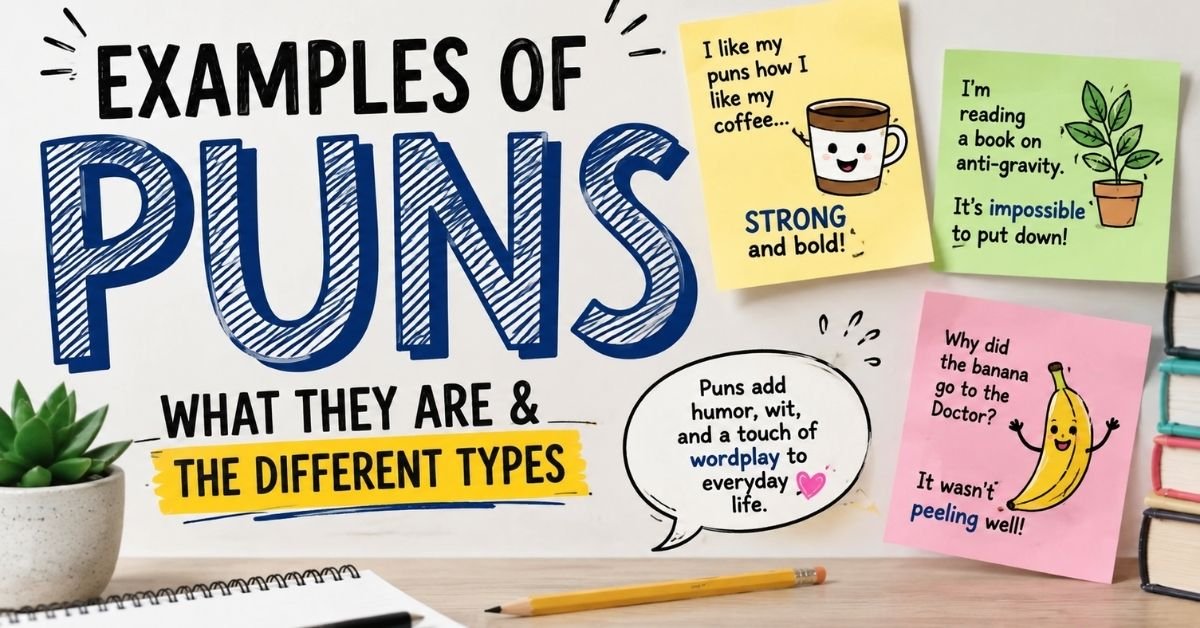
Examples of Puns: What They Are and the Different Types
Puns show up everywhere once you start noticing them in text messages, on coffee shop signs, in the middle of a serious meeting when someone can’t resist. If you’re looking for pun examples, trying to understand the different types of puns, or figuring out how to write one yourself, this guide covers all of it in one place.
You’ll find quick examples to use right away, a breakdown of how different pun types actually work, and practical tips for building your own wordplay from scratch.
What Is a Pun?
A pun is a joke that plays on the multiple meanings of a word, or on two words that sound alike but mean different things. The humor comes from that double meaning the listener expects one interpretation, then realizes another one fits just as well, or better.
Puns fall under the broader idea of wordplay, and the formal term for this kind of joke is paronomasia. You don’t need to remember that word to enjoy or write a good pun, but it’s useful to know if you ever come across it in a vocabulary list or English class.
What makes a pun work is timing and clarity. The reader or listener needs to catch both meanings quickly, without the joke needing to be explained afterward.
Is a Pun a Figure of Speech?
Yes, a pun counts as a figure of speech. Figures of speech are ways of using language beyond its most literal function, and a pun does exactly that by exploiting a word’s sound or meaning for comic effect.
It’s a little different from figures of speech like metaphor or simile, though. Those work by comparison describing one thing in terms of another. A pun works by ambiguity: the words themselves genuinely carry two valid meanings, and the joke lives in that overlap.
10 Quick Examples of Puns
Here’s a fast set of pun examples covering a range of subjects and styles, before we get into how each type works.
- The math teacher’s calculator broke, so now he has to count on himself.
- I used to be a baker, but I couldn’t make enough dough.
- The invisible man turned down the job offer he just couldn’t see himself doing it.
- A book about anti-gravity is impossible to put down.
- I stayed up all night wondering where the sun went, and then it dawned on me.
- The scarecrow won an award because he was outstanding in his field.
- I’m reading a book on the history of glue I just can’t seem to put it down.
- The origami teacher wanted to retire, but he kept folding under pressure.
- Two fish are in a tank. One turns to the other and asks, “Do you know how to drive this thing?”
- I wasn’t originally going to get a brain transplant, but then I changed my mind.
Read More About : What Is a Pun? Meaning, Types, Examples & How They Work
Types of Puns
Not every pun works the same way. Some rely on sound, others on spelling, and others on stacking more than one joke into a single line. Understanding these categories makes it easier to recognize a pun when you see one and easier to build your own once you know which lever you’re pulling.
Homophonic Puns
A homophonic pun uses words that sound alike but are spelled differently and mean different things. This is the most common type of pun, since English has so many word pairs that sound identical or nearly identical out loud.
- The wedding was so emotional that even the cake was in tiers.
- I didn’t like my beard at first, but then it grew on me.
- A boiled egg in the morning is hard to beat.
- The music teacher got locked in the piano and couldn’t find the right key.
- I tried to catch fog yesterday. Mist.
Homographic Puns
Homographic puns rely on words spelled exactly the same way but carrying two different meanings. They tend to work best in writing, since the joke depends on how the word reads, not necessarily how it sounds.
- The bandage was wound around the wound.
- A backward poet writes inverse.
- The soldier who survived mustard gas and pepper spray is now a seasoned veteran.
- I didn’t want to believe my dentist was pulling my tooth, but the signs were there.
- Vegetarians get all the beet.
Homonymic Puns
Homonym is the umbrella term for words that share the same spelling, the same sound, or both while carrying different meanings. Every homophonic and homographic pun technically counts as a homonymic pun, but the category also covers wordplay that doesn’t fit neatly into either narrower group.
- A well-known fact about wells is that they’re always in the ground.
- The bat flew out of the cave right as the batter walked up to the plate.
- I asked the librarian if the library had books on paranoia. She whispered, “They’re right behind you.”
- The bank teller was fired for interest in the wrong things.
Compound Puns
A compound pun stacks two or more pieces of wordplay into a single joke, so the punchline requires connecting more than one meaning at once. These often take a little longer to land because there’s more for the listener to piece together.
- Two peanuts walked into a bar. One was a-salted.
- A thief who stole a calendar got twelve months.
- The butcher backed into his meat grinder and got a little behind in his work.
- A man walked into a library and asked for books about paranoia. The librarian said, “They’re right behind you,” then added that they were also checked out under a false name which felt oddly appropriate.
Visual Puns
A visual pun uses imagery instead of, or alongside, words to create the double meaning. You’ll see this most often in logo design, memes, and illustrations, where the joke depends on what the image shows rather than what it says.
A moving company that uses a snail carrying a house on its shell is playing on the idea of “moving” both literally and slowly. A tailor’s logo shaped like a pair of scissors forming the letter “T” is doing something similar the shape itself carries the pun. Memes that pair an unrelated image with a caption that only makes sense once you connect the two also fall into this category.
Phrase-Based Puns
Phrase-based puns take a familiar expression, idiom, or saying and twist one part of it for a new meaning. Because these rely on phrases most people already know, they tend to land quickly.
- I’m on a seafood diet. I see food, and I eat it.
- Time flies when you’re a clock repair shop owner.
- Old accountants never die, they just lose their balance.
- I used to be indecisive, but now I’m not so sure.
- Energizer Bunny arrested charged with battery.
Pun Examples in Sentences
Seeing a pun inside a full sentence or exchange makes it easier to spot how the wordplay fits naturally into context, rather than standing alone as a fragment.
- After the marathon, she said her legs felt like noodles mostly because she’d eaten pasta the night before.
- “Why did the golfer bring two pairs of pants?” “In case he got a hole in one.”
- The electrician’s business was struggling, but he was confident he could turn things around once he got a current job.
- “I used to work at a shoe recycling shop,” he said. “It was sole-destroying.”
- When the astronaut asked for a raise, his boss said he’d have to launch that idea by someone else first.
- The optometrist ended every appointment the same way: “See you later.”
- “I only know 25 letters of the alphabet,” she admitted. “I don’t know Y.”
- After the flood, the plumber said business was really picking up.
Read More About : Need a Good Laugh? 199+ Funny Pun Examples to Keep You Giggling All Day
Simple Pun Examples
These are short, easy-to-catch puns that work well for casual use, kids, or anyone who wants humor that doesn’t require a second read.
- I’m friends with all electricians we have great current connections.
- The cheese factory tour was grate.
- I didn’t like the color of my new car, so I decided to change my paint of view.
- A skeleton doesn’t have the guts to go bungee jumping.
- The chef quit because he lost his thyme.
- I’d tell you a chemistry joke, but I know I wouldn’t get a reaction.
- The bicycle couldn’t stand on its own because it was two-tired.
- The clock in the hallway was fired for going back four seconds.
Funny and Clever Pun Examples
Not every pun aims for the same kind of laugh. Some are just plain silly, some make you pause and appreciate the setup, and some are so obviously groan-worthy that the badness is the whole point.
Funny Pun Examples
- I told my computer I needed a break, and now it won’t stop sending me Kit Kats.
- A cartoonist was found dead in his home. Details are sketchy.
- The gym near my house closed down. It just couldn’t work out.
- My friend’s bakery burned down last night. Now his business is toast.
- I got a job at a calendar factory, but I got fired because I took a couple of days off.
- Whiteboards are remarkable.
Clever Pun Examples
- The novelist’s second book fell flat turns out you can’t judge a sequel by its cover charge.
- Every meeting the committee held about daylight saving time somehow ran long, which felt like proof they hadn’t sprung forward at all.
- The astronomer refused to argue with anyone about the moon. She said some things are simply beyond her reach.
- A locksmith who lost his job said he just couldn’t find the right opening.
- The mathematician who studied infinity never finished a single conversation on the subject.
Terrible Puns That Are So Bad They’re Funny
This category often called dad jokes leans into obvious, almost lazy wordplay on purpose. The badness is the punchline.
- What do you call a fish with no eyes? A fsh.
- I used to be a banker, but I lost interest.
- What did the ocean say to the shore? Nothing, it just waved.
- I only have myself to blame for my terrible sense of direction. I really lost my way with that one.
- What do you call cheese that isn’t yours? Nacho cheese.
- I’m reading a book about mazes. I got lost in it.
Pun Examples in Everyday Language
Puns don’t only live in joke books they show up naturally in ordinary conversation, texting, and small talk once you start listening for them.
- At the coffee shop: “I’m not a morning person, but I’m definitely an espresso person.”
- In a group chat about weekend plans: “Count me out I’m swamped, and not the fun kind of wetland.”
- At the gym: “Leg day again? I guess I’m really committed to this squat life.”
- During a rainy commute: “This weather is really testing my drive.”
- At a family dinner: “Pass the gravy I’m not about to make a mistake by skipping it.”
- In a work email about a delayed project: “We’re behind schedule, but we’re working on catching up-date.”
- At a birthday party: “Another year older, another excuse to loaf around and eat cake.”
- Waiting in line at the DMV: “This line is really testing my patience and my license renewal.”
Puns in Headlines and Advertising
Puns show up often in advertising and headlines because they’re memorable, they catch attention fast, and a good one gives the reader a small reward for reading closely. Some of these are written on purpose by copywriters and headline editors; others happen by accident, when a sentence turns out to carry an unintended second meaning.
Intentional wordplay in branding and advertising:
- A dry cleaner using the line “Drop your pants here.”
- A window-washing company slogan: “We see clearly now.”
- A bakery calling its loyalty program the “Whisk List.”
Classic examples of accidental double meanings in headlines (the kind that circulate widely as illustrations of how ambiguous phrasing can accidentally create a pun):
- “Farmer Bill Dies in House” (referring to a bill in the House of Representatives, not a person named Bill).
- “Eye Drops Off Shelf” (referring to a product being discontinued, not literally falling).
- “Local High School Dropouts Cut in Half” (meant as a statistic, not a description of an event).
These accidental examples are widely cited illustrations of how ambiguous sentence structure can create a pun without anyone intending one worth treating as examples of the phenomenon rather than verified quotes from a specific outlet.
Read More About : Zoning Out? These 150+ Coffee Puns Will Perk You Right Up!
Pun Examples in Literature
Wordplay has a long history in written language, going back centuries before the internet turned puns into shareable one-liners. Writers have used puns to add wit, tension, or double meaning to dialogue and prose for as long as literature has existed in its modern form.
Famous Examples of Puns in Literature
William Shakespeare is one of the most frequently cited users of puns in English literature. In Romeo and Juliet, the dying Mercutio plays on the word “grave,” saying that tomorrow he will be found to be a “grave man” meaning both serious and buried. It’s a dark joke that works because both meanings apply at once.
Lewis Carroll leaned heavily on wordplay throughout Alice’s Wonderland stories, often building entire exchanges around a character taking a word literally when it was meant figuratively, or the reverse. That style of confusion-based wordplay is closely related to punning, even when it isn’t a strict single-word pun.
Modern novelists and poets continue the tradition, often using a pun in a title or chapter heading to hint at a story’s theme before the reader even starts.
Pun Examples for Students
Puns are a useful teaching tool because they force a reader to notice that words can carry more than one meaning a skill that supports reading comprehension and vocabulary building. These examples work well for a classroom setting or as a way to introduce the concept of wordplay.
- The math book looked sad because it had too many problems.
- Seven ate nine that’s why nine turned to eight.
- The library added a wing, and now it has even more shelf-esteem.
- Photosynthesis is a plant’s favorite subject because it’s where they really grow.
- The history teacher said the past was tense, but the future looked bright.
Why Writers Use Puns
Writers reach for puns for a few practical reasons. A pun can make a line more memorable than a straightforward sentence would be, since the reader has to briefly process two meanings, and that small mental effort tends to stick. Puns can also lighten a tone, signal a writer’s voice, or add emphasis to a specific word by drawing attention to it in an unexpected way.
In dialogue, a pun can reveal something about a character quick wit, nervous deflection, or a habit of not taking things too seriously. In headlines and titles, a pun can compress a theme into a single memorable phrase instead of a longer, flatter description.
Part of why wordplay lands as humor in the first place comes down to a simple pattern: the listener expects one meaning, gets surprised by a second one, and then resolves the two almost instantly. That quick surprise-and-resolution is a big part of what makes a well-placed pun satisfying rather than just confusing.
How to Create Your Own Puns
Writing a pun is a skill you can practice, not something you either have or don’t. These four approaches cover most of the ground.
Look for Multiple Meanings
Start with a word connected to your topic that already has more than one meaning, then build a sentence where both meanings make sense. If you’re writing about a bakery, for example, the word “roll” works both as bread and as an action “the new hire really rolled into the job” plays on both at once.
Use Similar-Sounding Words
Pick a word from your topic and think of another word or phrase that sounds close to it. Swap it in and see if the sentence still makes sense with the new word’s meaning. This is the core technique behind homophonic puns, and it’s often the fastest way to generate a pun once you’ve got a subject in mind.
Play With Familiar Phrases
Take an idiom, saying, or well-known expression and change one word so it connects to your topic while keeping the phrase recognizable. The familiarity of the original phrase is what makes the twist land readers need to recognize the source expression for the joke to register.
Keep the Context Clear
A pun only works if the audience can catch both meanings quickly. Keep the surrounding sentence simple and avoid stacking the pun with extra jargon or unrelated details that might bury the joke. If a listener needs the pun explained to them, it’s already stopped being funny.
Read More About : 850+ Best Avocado Puns: Short, Cute, Dirty, Birthday One-Liners, Captions & Jokes
Common Mistakes When Writing Puns
Even a decent wordplay idea can fall flat if it’s delivered the wrong way. These are some of the most common ways puns miss.
- Over-explaining the joke. Adding “get it?” or spelling out both meanings kills the surprise that makes a pun work.
- Forcing a connection that isn’t really there. If the two meanings only loosely relate, the pun reads as a stretch rather than a joke.
- Stacking too many puns in a row. One well-placed pun stands out; five in a paragraph start to feel exhausting rather than clever.
- Choosing an obscure reference. If the audience doesn’t recognize the phrase or word being played with, the joke won’t land no matter how clever the wordplay is.
- Mistiming the delivery. A pun dropped into a serious moment, without any signal that a joke is coming, often reads as confusing rather than funny.
When and Where to Use Puns
Puns tend to work best in casual, low-stakes settings: social media captions, birthday cards, party invitations, text messages, and light marketing copy. They’re a good way to add personality to a caption or make a greeting card feel less generic, and they’re common in gift tags, party signage, and playful workplace messages like a retirement announcement or a team celebration.
They tend to work less well in formal writing, serious announcements, or situations where the tone needs to stay consistently professional a legal document, a condolence message, or a safety notice are not the place for wordplay, since a pun can come across as dismissive of the moment even if that’s not the intent.
A good general rule: if the setting already allows for a joke, a pun usually fits. If the setting calls for careful, literal language, it’s worth leaving the wordplay out.
Why Are Puns So Popular?
Part of what keeps puns popular is how accessible they are. Unlike jokes that depend on niche references or long setups, a pun usually only needs a shared understanding of a common word or phrase, which means almost anyone can get the joke and, often, come up with one of their own.
Puns also create a small shared moment between the person telling the joke and the person hearing it there’s a quick “I see what you did there” reaction that connects the two. That instant recognition is part of why puns spread easily online and why they’ve stuck around in casual conversation, headlines, and advertising for so long.
They also cross generations easily. A pun that works for a classroom of kids can work just as well in an office group chat, which gives this kind of wordplay unusually broad reach compared to other humor styles.
Frequently Asked Questions
What is an example of a pun?
“I used to be a baker, but I couldn’t make enough dough” is a pun, since “dough” refers both to bread ingredients and to money.
Which sentence is an example of a pun?
“The electrician was shocked to find out he’d been overpaid” is a pun sentence “shocked” plays on both the emotional reaction and the literal hazard of the electrician’s job.
What is an example of playing with words?
Wordplay is the broader category that includes puns, along with things like rhymes, spoonerisms, and deliberate misspellings for effect. A simple example is describing a slow-moving line as “a real snail’s pace of a wait” playing with the phrase for comic emphasis rather than relying on a strict double meaning.
What does the term pun mean?
A pun is a joke built on a word’s double meaning or on two words that sound alike but mean different things, used to create a humorous or clever effect.
What is a pun as a figure of speech?
A pun is a figure of speech that uses ambiguity in sound or meaning for comic or rhetorical effect, distinct from comparison-based figures of speech like metaphor or simile.
What are the main types of puns?
The main types are homophonic (sound-alike words), homographic (same spelling, different meaning), homonymic (the broader category covering both), compound (multiple wordplay elements in one joke), visual (image-based wordplay), and phrase-based (twisting a familiar expression).
How do you identify a pun?
Look for a word or phrase in the sentence that makes sense in more than one way at once. If reading it a second way changes or adds to the meaning, and that shift creates the joke, it’s a pun.
Conclusion
Puns work because they ask very little of the reader and reward them right away, a quick double take, a small moment of recognition, and a laugh or a groan depending on how far the wordplay was pushed. Whether you’re picking one for a card, testing your own version out on friends, or just wanted a break with some good one-liners, the range covered here should give you plenty to work with, from the simplest homophone swap to a fully layered compound joke.